Nanocarriers, with the evidence
We develop lipid nanocarrier systems for cosmetic and dermal actives – and we measure what actually happens to them, using methods most formulation laboratories do not have.
The problem we solve
Many of the most effective actives are poorly soluble, unstable, or simply do not reach the layers of skin where they would work. A nanocarrier can fix that. The difficulty is knowing whether it did.
What We Do
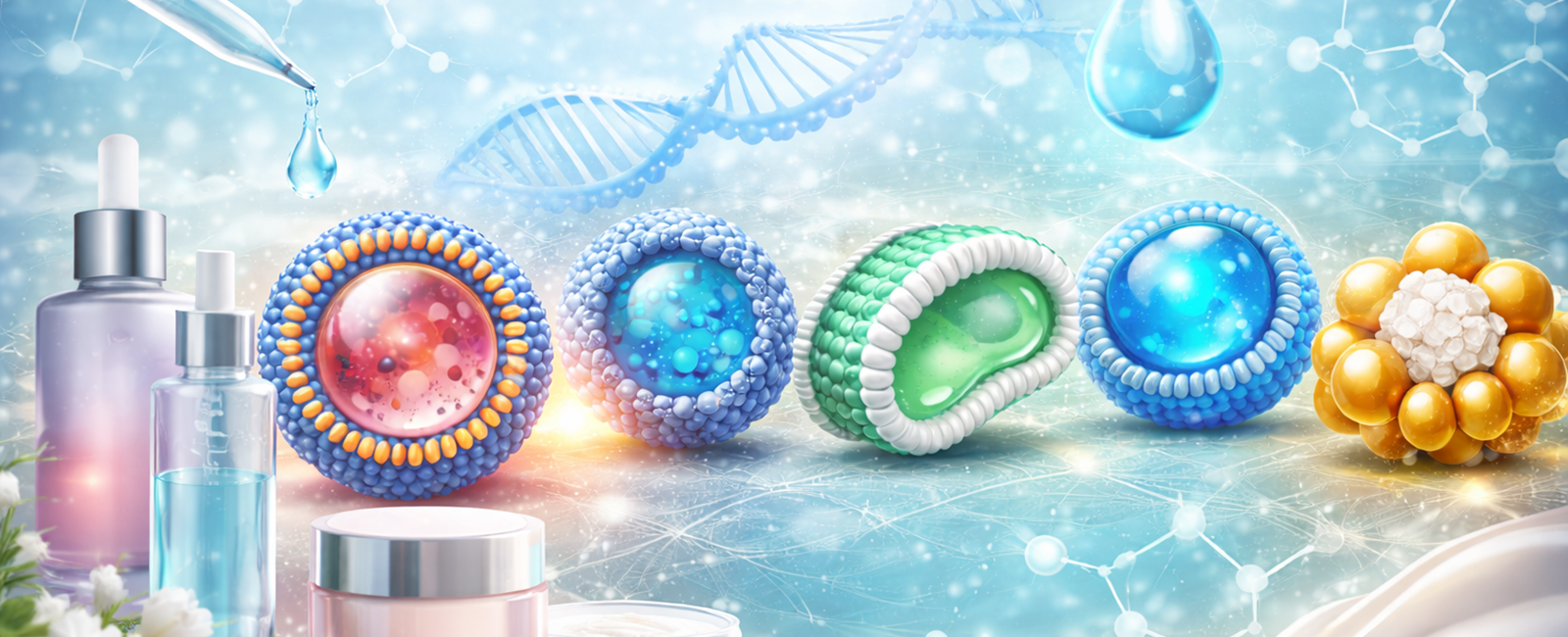
We design and produce nanocarrier platforms tailored to a specific active and a specific formulation goal:
- Liposomes
- Transfersomes
- Ethosomes
- Solid lipid nanoparticles (SLN)
- Nanostructured lipid carriers (NLC)
- Custom nano-vesicular systems
Applications range from improved skin penetration and controlled release to protection of oxidation-sensitive actives and extended shelf life.
What makes us different
Most suppliers characterise a carrier by particle size, zeta potential and encapsulation efficiency. Those numbers describe the particle. They do not tell you whether your active is genuinely inside the bilayer or merely adsorbed on the surface – and they say nothing at all about how far it travels into skin.
We answer both questions directly, using electron paramagnetic resonance (EPR) spectroscopy and EPR imaging – techniques normally found in physics departments rather than in formulation houses:
- Where the active sits. Spin labelling shows whether a molecule is incorporated into the lipid bilayer or adsorbed on it, and how it changes the order and fluidity of the carrier membrane. Two formulations with identical encapsulation efficiency can behave completely differently, and this is why.
- How deep it goes. Two-dimensional L-band EPR imaging follows the carrier and its payload into an ex vivo skin model, non-invasively and depth-resolved, without extracting, sectioning or destroying the sample.
- Whether it protects the active. EPR spin trapping measures antioxidant performance against biologically relevant radicals – hydroxyl, superoxide, nitric oxide – not against DPPH.
How we work
Development projects run from an initial formulation problem to a characterized prototype. We supply pilot batches for R&D and evaluation, and every batch is delivered with a full characterization report:
- Size distribution and polydispersity index by dynamic light scattering
- Zeta potential
- Encapsulation and cargo localization verified by EPR
- Composition by HPLC
Who we are
NanoSphere Systems is being incorporated in 2026 as a spin-out of BioScope Labs, at the Faculty of Physical Chemistry, University of Belgrade. Our scientific team brings more than twenty years of work in physical chemistry, nanotechnology and formulation science, and over one hundred international publications.